Last updated: March 2026. Covers all 10 Straw Hat crew statues, maps, transportation, Kumamoto Castle, and a recommended 2-day itinerary for visiting every statue.

In April 2016, two massive earthquakes hit Kumamoto Prefecture. Eiichiro Oda — the creator of One Piece, born and raised in Kumamoto — responded with a donation of ¥800 million (roughly $8 million USD). The money went to reconstruction. In return, Kumamoto created something permanent: ten bronze statues of the Straw Hat Pirates, scattered across the towns and cities that were hit hardest.
The first statue — Luffy, arm raised outside the Kumamoto Prefectural Government office — went up in November 2018. The last — Jinbe, standing watch at a coastal park — was completed in July 2022. Together they form a tour that takes you across the entire prefecture, from Kumamoto city center to the volcanic caldera of Aso to the rural towns most tourists never see.
This guide covers every statue, how to reach them, and the most practical way to see them all — if you have one afternoon or three days.
- All 10 Statues: Locations and Characters
- The Luffy Statue — Kumamoto City
- The Chopper Statue — Kumamoto City Zoo
- The Aso Region Statues — Usopp, Franky, Robin
- The Scattered Statues — Zoro, Sanji, Nami, Brook, Jinbe
- How to See All 10: Transportation Options
- Recommended 2-Day Itinerary (By Car)
- Getting to Kumamoto
- Kumamoto Castle — Don’t Skip It
- One Piece Merchandise in Kumamoto
- Kumamoto City Transportation
- Frequently Asked Questions
- More Pilgrimage Guides
All 10 Statues: Locations and Characters
| # | Character | Location | Area | Public Transport |
| 1 | Monkey D. Luffy | Kumamoto Prefectural Government Office | Kumamoto City | Easy — tram stop nearby |
| 2 | Tony Tony Chopper | Kumamoto City Zoo & Botanical Garden entrance | Kumamoto City | Easy — tram + 5 min walk |
| 3 | Roronoa Zoro | Park near Higo-Ozu Station | Ozu Town | Moderate — short walk from station |
| 4 | Nami | Nishihara Village area | Nishihara | Difficult — bus required |
| 5 | Usopp | In front of Aso Station | Aso City | Easy — at the train station |
| 6 | Sanji | Mashiki Gymnasium area | Mashiki Town | Difficult — bus/car needed |
| 7 | Nico Robin | Kumamoto Earthquake Memorial Museum | Minami-Aso | Difficult — bus/car needed |
| 8 | Franky | Near Takamori Station | Takamori Town | Moderate — near station |
| 9 | Brook | Near the Dinosaur Museum | Mifune Town | Difficult — bus/car needed |
| 10 | Jinbe | Sumiyoshi Kaigan Park | Uto City | Difficult — bus/car needed |
The Luffy Statue — Kumamoto City
The Luffy statue is the most visited of the ten and the easiest to reach. It stands at the entrance promenade of the Kumamoto Prefectural Government Office, surrounded by ginkgo trees. Luffy’s got his arm raised — the classic pose — and at the base you’ll find a cast of Eiichiro Oda’s actual hand print and his signature.
The statue is 174 centimeters tall (Luffy’s canonical height) and made of bronze. There’s almost always someone taking photos with it. Visit early morning or late afternoon for the best light and fewer crowds.
| Location | Kumamoto Prefectural Government Office, 6-18-1 Suizenji, Chuo-ku, Kumamoto |
| Access | Kumamoto City Tram — “Kencho-mae” (県庁前) stop, then 1 min walk |
| Hours | 24/7 outdoor access (the statue is in the open promenade) |
| Cost | Free |
The Chopper Statue — Kumamoto City Zoo
Chopper stands at the main entrance of Kumamoto City Zoological and Botanical Gardens — a fitting location for the crew’s doctor who was, after all, a reindeer first. The statue is smaller than Luffy’s (matching Chopper’s compact stature) and positioned so that visitors can pose alongside him.
If you have time, the zoo itself is a pleasant stop — well-maintained with a botanical garden section that’s particularly nice in spring. But even if you just want the photo, the statue is accessible without entering the zoo.
| Access | Kumamoto City Tram to “Doubutsuen-iriguchi” (動植物園入口) stop, then 5 min walk |
| Cost | Statue: Free (outside the gate). Zoo admission: ¥500 (adults) if you want to enter. |

The Aso Region Statues — Usopp, Franky, Robin
Three statues are in the Aso area — the volcanic caldera region northeast of Kumamoto city. This is the area that was hardest hit by the 2016 earthquakes, and placing the statues here was intentional. Each location connects to the reconstruction story.
Usopp stands right in front of Aso Station — making him the easiest Aso statue to visit by public transport. The station itself was damaged in the earthquakes and rebuilt, and Usopp’s pose captures that spirit of rebuilding with optimism (and characteristic exaggeration).
Franky is near Takamori Station at the opposite end of the Aso area. Takamori is a small town known for its tunnel spring water and rural atmosphere. The station is the terminus of the Minami-Aso Railway, which was itself severely damaged in 2016 and has since been restored — another reconstruction story.
Nico Robin stands at the Kumamoto Earthquake Memorial Museum, which is the former Tokai University Aso Campus. The campus was abandoned after the earthquake, and the damaged buildings have been preserved as a memorial. Robin — the crew’s archaeologist who preserves history — guards the entrance. It’s the most emotionally resonant statue location of the ten.
The Aso caldera is worth the trip even without the statues. The volcanic landscape, Mount Aso’s smoking crater, the Kusasenri grasslands, and the hot springs make this one of Kyushu’s most spectacular natural areas. Plan to spend a full day combining the statues with the scenery.
The Scattered Statues — Zoro, Sanji, Nami, Brook, Jinbe
The remaining five statues are spread across different towns in Kumamoto Prefecture. Each was placed in a community severely affected by the earthquake:
Zoro (Ozu Town) — Near Higo-Ozu Station, walkable from the platform. One of the more accessible outlying statues.
Sanji (Mashiki Town) — At the Mashiki Gymnasium area. Mashiki was the epicenter of the earthquake, and the town’s reconstruction has been one of the prefecture’s biggest projects. Getting here requires a bus or car.
Nami (Nishihara Village) — In the Nishihara area between Kumamoto city and Aso. Bus connections exist but are infrequent — a car is recommended.
Brook (Mifune Town) — Near the Dinosaur Museum. Mifune is known for its dinosaur fossil discoveries, and Brook — the skeleton musician — fits right in. Car or bus required.
Jinbe (Uto City) — The last statue completed (July 2022), standing at Sumiyoshi Kaigan Park on the coast. Jinbe, as the crew’s helmsman and former fishman pirate, watches over the sea. Bus connections from Kumamoto Station exist but require planning.
How to See All 10: Transportation Options
Option 1: Rental Car (Recommended)
This is the most practical way to see all ten statues. The statues are spread across roughly 200 kilometers of the prefecture, and five of them are in locations with limited public transport. A rental car lets you see all ten in 1.5 to 2 days at a comfortable pace.
Rent from Kumamoto Station — several major rental companies (Toyota, Nippon, Times) have offices right at the station. A compact car costs roughly ¥5,000–8,000 per day including insurance. Roads are well-maintained and mostly uncrowded outside Kumamoto city center.
International Driving Permit required. Japan does not accept foreign licenses alone. Get your IDP before leaving home — it takes minutes at most automobile associations and is valid for one year. Japan drives on the left.
Option 2: Public Transport + Walking
You can visit 5-6 statues by public transport without too much difficulty: Luffy, Chopper (both in Kumamoto city by tram), Usopp (Aso Station), Franky (Takamori Station), and Zoro (Higo-Ozu Station). The remaining statues require bus connections with infrequent schedules — possible but requires careful timetable planning.
Budget 3-4 days to visit all ten by public transport. The blog “Higo Journal” has documented the full route by public transport — it’s doable but requires patience.
Option 3: Guided Tour
Private guides and tour services offer One Piece statue tour packages. This is the stress-free option — someone drives you to all ten, handles the navigation, and often includes stops at Kumamoto Castle and local restaurants. Prices vary, but expect ¥15,000–30,000 per person for a full-day tour.

Recommended 2-Day Itinerary (By Car)
| Day 1: Kumamoto City + Southern Statues | |
| 9:00 | Pick up rental car at Kumamoto Station |
| 9:30 | Luffy — Prefectural Government Office (15 min) |
| 10:00 | Chopper — Zoo & Botanical Garden (15 min + optional zoo visit) |
| 11:00 | Kumamoto Castle — Walk the grounds, see the restored main keep (90 min) |
| 12:30 | Lunch in downtown Kumamoto (try Kumamoto ramen or basashi horse sashimi) |
| 14:00 | Sanji — Mashiki Gymnasium (30 min drive + 15 min) |
| 15:00 | Brook — Mifune, near Dinosaur Museum (30 min drive + 15 min) |
| 16:00 | Jinbe — Sumiyoshi Kaigan Park, Uto (40 min drive + 15 min) |
| Evening | Return to Kumamoto city. Dinner in the Shimotori arcade area. |
| Day 2: Aso Region + Northern Statues | |
| 8:30 | Drive to Aso region (60 min from Kumamoto city) |
| 9:30 | Zoro — Park near Higo-Ozu Station (15 min) |
| 10:15 | Nami — Nishihara Village (20 min drive + 15 min) |
| 11:00 | Robin — Earthquake Memorial Museum (30 min drive + 30 min for the memorial) |
| 12:00 | Usopp — Aso Station (20 min drive + 15 min) |
| 12:30 | Lunch near Aso — try aka-ushi (red beef), the local specialty |
| 14:00 | Franky — Near Takamori Station (30 min drive + 15 min) |
| 15:00 | Optional: Mount Aso crater viewpoint or Kusasenri grasslands |
| 17:00 | Drive back to Kumamoto city, return rental car |
Getting to Kumamoto
| From Fukuoka | Kyushu Shinkansen: 30-40 min, ¥5,310. Highway bus: ~2 hours, ¥2,500. |
| From Tokyo | Flight: 1h 45min (26 daily flights). Shinkansen: ~6 hours with transfer. |
| From Osaka | Flight: 1h 10min (~10 daily flights). Shinkansen: ~3 hours via Hakata. |
If you have a Japan Rail Pass: The Kyushu Shinkansen from Hakata (Fukuoka) to Kumamoto is covered. This makes a side trip from Fukuoka incredibly easy — you can even do a day trip.

Kumamoto Castle — Don’t Skip It
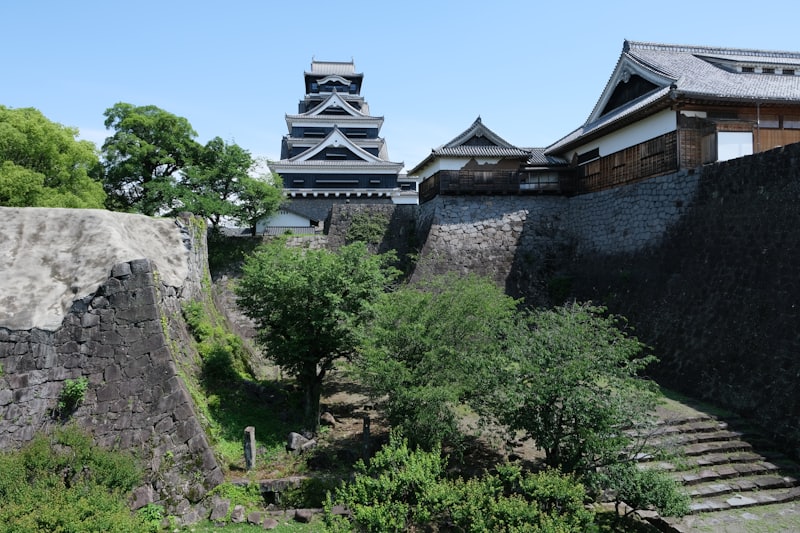
While you’re in Kumamoto for the statues, Kumamoto Castle is essential. The castle was severely damaged in the 2016 earthquake — the same event that inspired the One Piece statue project — and has been undergoing reconstruction since. The main keep reopened in 2021 with all six floors accessible, and a special viewing passage lets you observe the ongoing restoration work up close.
The connection between the castle’s reconstruction and the One Piece statues isn’t coincidental. Both represent Kumamoto’s recovery. Standing at the restored castle and then visiting the statues gives the entire experience an emotional weight that goes beyond fandom tourism.
| Admission | ¥800 |
| Access | Kumamoto City Tram — “Kumamotojo-mae” stop, then 10 min walk |
| Hours | 9:00–17:00 (last entry 16:30) |
| Best time | Late March – early April for cherry blossoms |
One Piece Merchandise in Kumamoto
Several shops in Kumamoto sell statue-related merchandise and Kumamoto-exclusive One Piece goods:
Sakuramachi Shopping Center (B1) — A One Piece souvenir shop with Kumamoto-exclusive items, including Kumamon plush toys dressed in Luffy’s outfit. Located in the basement level of the city’s main bus terminal building.
Mugiwara Store Kumamoto — Inside Kumamoto Station’s shopping area. The standard Mugiwara Store lineup plus some Kumamoto-exclusive goods.
There’s also an ongoing exhibition at the Kumamoto Prefectural Museum of Art running through May 2026, marking the 10th anniversary of the earthquakes with a One Piece collaboration. If your visit falls within this period, it’s worth checking out. Admission is free.
Kumamoto City Transportation
Kumamoto’s tram system is the most useful public transport for the city-center statues:
| Tram fare | ¥200 flat rate (adult), ¥100 (child) |
| Payment | IC cards (Suica, Pasmo, ICOCA all work), cash, or credit card tap |
| 1-Day Pass | ¥700 (tram only, paper ticket) or ¥500 (mobile app). Tram + bus combined: ¥900 (wakuwaku 1day pass) |
| Coverage | 2 lines covering Kumamoto Station, castle area, downtown, Suizenji Garden |
The combined tram + bus day pass is excellent value. At ¥900 for the wakuwaku 1day pass, you’d break even after just 5 rides. If you’re spending a full day in Kumamoto city visiting the Luffy and Chopper statues, the castle, and downtown shopping, you’ll easily exceed that.
Frequently Asked Questions
Can I visit all 10 statues in one day?
By car, yes — but it’s a long day (8-10 hours of driving and stops). Two days is much more enjoyable. By public transport, realistically no — plan for 3-4 days.
Which statues can I see without a car?
Luffy and Chopper (Kumamoto City tram), Usopp (Aso Station), Franky (Takamori Station), and Zoro (Higo-Ozu Station) are all accessible by train. That’s 5 of 10 without needing a car.
Is it worth visiting just for Luffy?
If you’re passing through Kumamoto or Kyushu, definitely. The Luffy statue plus Kumamoto Castle makes a solid half-day visit. You don’t need to see all ten to have a meaningful experience.
Are the statues well-signed and easy to find?
Yes. Each statue has signage in Japanese and English, and the prefectural tourism office provides maps. The Google Maps locations for all ten statues are accurate.
Best season to visit?
Late March to early April for cherry blossoms at Kumamoto Castle. Avoid winter for the Aso region statues — the caldera roads can be icy, and some mountain passes close in heavy snow.
Is there an official stamp rally or completion certificate?
Kumamoto has run special campaigns with stamp rallies and collectible cards at various times. Check the official ONE PIECE Kumamoto Revival Project website for current programs.
More Pilgrimage Guides

Written by Takapon
Born and raised in Kyoto, currently in Tokyo. Former management consultant turned anime culture writer. Has visited countless collaboration cafes and pilgrimage spots across Japan. Also sharing tips on Instagram @pop_now_jp.
Follow @pop_now_jp on Instagram