Last updated: March 2026.
What Are Japanese Game Centers?
Game centers (ゲームセンター, often shortened to “gēsen”) are multi-floor entertainment buildings found across every major city in Japan. Unlike Western arcades that mostly disappeared in the 2000s, Japanese game centers are thriving in 2026 — and they’ve evolved into something far more interesting than rows of old cabinets.
A typical game center in Tokyo has 3–6 floors, each dedicated to a different type of game: crane games (UFO catchers) on the ground floor, rhythm games on one floor, fighting games on another, photo booths (purikura) for groups, and sometimes even medal games (Japan’s version of slot machines, but for tokens you can’t cash out). The major chains — Taito Station, GiGO (formerly SEGA), and Round1 — are everywhere, but smaller independent arcades still exist in areas like Akihabara and Nakano.
For tourists, game centers are one of the most immediately fun things you can do in Japan. No Japanese language required, no reservation needed, and you can spend anywhere from ¥100 to ¥10,000+ depending on how deep you go. They’re open late (most until 23:00–midnight, some 24 hours), making them great for evenings after dinner or when you need a break from sightseeing.
Types of Games You’ll Find (Floor by Floor)
Crane Games / UFO Catchers (1F–2F)
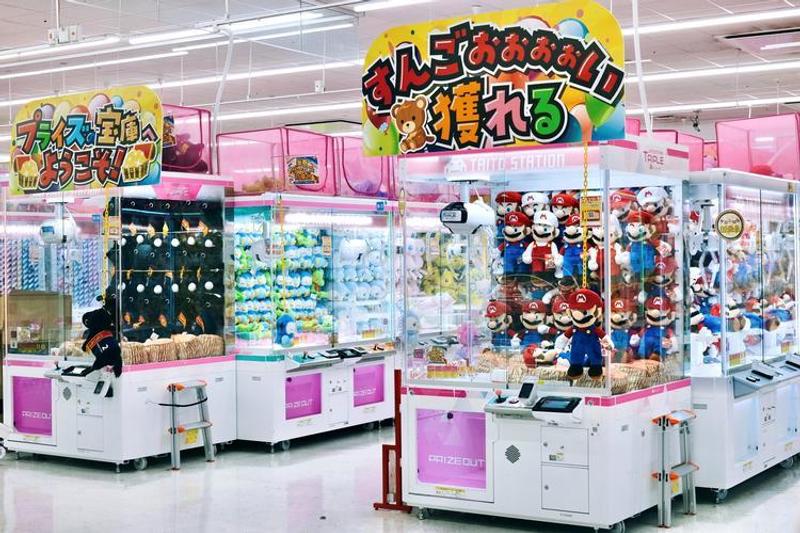
This is what draws most tourists in. Crane games dominate the ground floors of every game center, and in 2026, there are entire buildings dedicated exclusively to them. The prizes are the real attraction — officially licensed anime figures, plush toys, snacks, and limited-edition items that often can’t be bought anywhere else.
Japanese crane games are fundamentally different from Western claw machines. Instead of a weak claw that almost never grabs anything, Japanese machines use dozens of different prize-winning mechanics: push games where you nudge a box toward an edge, bridge games where you knock a prize off two bars, ring hooks, seesaw setups, and more. Each machine type requires a different strategy, and staff will often reposition prizes or give you tips if you ask.
Cost: ¥100–¥500 per play (most common: ¥100–¥200). Staff will sometimes give you extra plays or adjust the prize if you’ve spent ¥500+ without winning.
Pro tip: Watch other players before you spend money. Observe which machines are close to paying out. And don’t be shy about asking staff for help — in Japanese game centers, this is completely normal and expected. Many staff members will show you the optimal drop point or even reset the prize to a more winnable position.
Rhythm Games (2F–3F)
Japan’s rhythm game scene is massive, and game centers are where it lives. These aren’t just “press buttons to the beat” — the machines are elaborate, often with full-body movement, touchscreens, or specialized controllers.
Popular titles in 2026:
maimai DX — a circular screen you tap and slide around. Hugely popular, often with lines on weekends. The machine plays J-pop, anime songs, and Vocaloid tracks.
CHUNITHM — a flat panel you slide your hands over, with an air sensor above for vertical movement. Extremely satisfying once you get the feel.
Taiko no Tatsujin — the famous drum game. Hit the drum in time with the music. Accessible for beginners, deep for experts. Anime songs, J-pop, classical — huge song list.
SOUND VOLTEX — knobs and buttons, heavy electronic music focus. Steep learning curve but addictive.
Dance Dance Revolution / DANCERUSH STARDOM — full-body dance games. DDR uses arrow panels; DANCERUSH uses a flat LED floor.
Cost: ¥100 per play (usually 3 songs). Some machines accept IC cards (Amusement IC / Aime / e-amusement pass) to save your scores and progress — you can buy these cards at the game center for ¥300.
Fighting Games & Competitive Games (3F–4F)
Japanese game centers are where competitive gaming started, and the fighting game community (FGC) is still deeply rooted in arcades. You’ll find cabinets for Street Fighter 6 Type Arcade, Tekken 8, Guilty Gear Strive, and Gundam VS series. The atmosphere on these floors is intense — serious players with their own arcade sticks, completely focused.
As a tourist, these floors are worth visiting even if you don’t play competitively. The energy is incredible, and most cabinets let you jump in for ¥100. Just be aware that the skill level is high — you’ll likely get destroyed quickly, but that’s part of the experience.
Medal Games (Sometimes Separate Floor)
Medal games use tokens (medals) instead of money. You buy medals from a machine (¥1,000 for ~200 medals is typical), then play slot-machine-style games, horse racing sims, or massive multi-player coin pushers. Important: You cannot exchange medals back for money — this is how Japan keeps these games legal. You can store unused medals on a membership card for your next visit.
These floors tend to attract older Japanese players and are usually quieter. As a tourist experience, the giant coin pusher machines are truly entertaining — they’re mechanical marvels with elaborate physical contraptions.
Purikura / Photo Booths (Usually Top Floor)
Purikura (プリクラ) are photo booth machines that take your picture and then let you decorate the photos with digital stamps, effects, text, and filters before printing them as sticker sheets. They’re a uniquely Japanese cultural experience — groups of friends (especially young women) regularly visit purikura as a social activity.
Note: Many purikura floors have a “women only” or “mixed groups only” policy — single men are often not allowed on the purikura floor. This is a long-standing rule to prevent creepy behavior and is strictly enforced.
Cost: ¥400–¥600 per session (usually for 2+ people to share).
Where to Find the Best Game Centers in Tokyo
Akihabara: The Highest Concentration
Akihabara has the densest collection of game centers in Japan. Within a 10-minute walk of the station, you’ll find:
Silk Hat Akihabara (シルクハット秋葉原) — The biggest game center in Akihabara as of late 2025, occupying the iconic red building next to the station’s Electric Town Exit that was formerly GiGO (and before that, Club SEGA). The building reopened in November 2025 under new operator Matahari Entertainment with a massive 9-floor layout: 4 entire floors of crane games (1F–4F), card games on 5F, rhythm games on 6F–7F, a Gundam EXVS2 arcade with 58 cabinets in the basement (the largest installation in Japan), and darts/goods on 8F. Open 10:00–24:00 daily — significantly later than most game centers. This is now the single most important arcade destination in Akihabara.
GiGO Akihabara 3rd & 5th — While GiGO’s famous main building (1号館) closed permanently in August 2025 after 33 years, GiGO still operates the 3rd and 5th locations nearby. The 3rd location is particularly good for crane games. Note: if you see old guides mentioning “GiGO Akihabara” as a single landmark, they’re referring to the now-closed 1号館.
Taito Station Akihabara — Right on the main street, easily spotted by the Space Invader logo. Multiple floors with a good mix of crane games, rhythm games, and retro cabinets. Staff are used to tourists and generally helpful.
Hey (HEY) — A beloved independent arcade that’s become legendary for retro gaming. Two floors packed with classic shoot-em-ups, fighting games from the ’90s and 2000s, and a community of dedicated regulars. If you care about arcade history, this is worth visiting.
Super Potato (retro game store with arcade floor) — Not a game center per se, but the top floor of this retro game shop has playable classic arcade cabinets. Worth combining with a shopping visit.
Shinjuku: Late Night Options
Taito Station Shinjuku East Exit — One of the biggest locations in the chain, with extended hours (10:00–01:00). Located in Kabukicho, making it a natural stop during an evening out. The crane game floors here are massive.
GENDA GiGO Shinjuku Kabukicho — Another large multi-floor game center right in the entertainment district. Good selection of rhythm games and fighting game cabinets.
Ikebukuro: Round1 Stadium
Round1 Stadium Ikebukuro is less of a traditional game center and more of an entertainment complex. Along with arcade games, it offers bowling, billiards, karaoke, darts, and even a sports area. You can buy time packages (roughly ¥2,500–¥2,800 for a few hours of access to most facilities). It’s ideal if you want variety beyond just arcade games, especially in a group.
Shibuya: Casual and Tourist-Friendly
Taito Station Shibuya — A multi-floor location near the station. The crane game floors are well-maintained and frequently restocked. Good for a quick session while exploring Shibuya.
Adores Shibuya — Known for purikura and crane games. Skews younger and more casual.
Odaiba: JOYPOLIS (Indoor Theme Park Arcade)
Tokyo Joypolis in Odaiba is SEGA’s indoor amusement park featuring VR attractions, roller coasters, and large-scale arcade games. It’s more theme park than game center, with an admission fee (¥1,500 entry (adults), or ¥5,800 for a passport that includes all rides). Worth it if you’re already visiting Odaiba, especially with kids or in bad weather.
How Much Money to Bring
Like gachapon, game centers are deceptively good at extracting money. Here’s what to expect:
Quick visit (30 minutes): ¥500–¥1,000. Play a few crane games and a rhythm game. This is enough to get the experience.
Moderate session (1–2 hours): ¥2,000–¥4,000. You’ll play multiple game types, probably win something from a crane game, and have a full arcade experience.
Deep dive (3+ hours): ¥5,000–¥10,000+. You’re hooked on the crane games, playing through rhythm game song lists, and losing track of time. This happens more often than you’d think.
Payment methods: Most machines still operate on ¥100 coins, but the shift to IC cards is accelerating in 2026. Many newer machines at Taito Station and GiGO accept Amusement IC cards, Suica/Pasmo, and even credit cards at charging stations. However, carry ¥100 coins as backup — older machines and smaller arcades are still coin-only.
Crane Game Strategy: How to Actually Win
Japanese crane games are built to be winnable — the business model relies on repeat customers who trust the machines are fair. Here are strategies that actually work:
Watch before you play. Stand back and observe the machine. Check how other prizes have been won (look at the discard bin nearby for empty boxes). See what position the current prize is in — is it close to the drop zone?
Ask the staff. This cannot be overstated. Japanese game center staff (especially at major chains) are trained to help customers win. If you’ve spent ¥500+ without winning, flag down a staff member. They will often reposition the prize to a more winnable angle, show you the correct technique, or give you a free play. This is standard practice, not special treatment.
Understand the machine type. The three most common types for tourists:
Bridge (橋渡し): The prize sits on two parallel bars. Your goal is to use the claw to shift one end of the box until it slips between the bars. Move one side at a time, alternating left and right.
Push (押し): A prize sits on a ledge. You need to push it forward or to the side until it falls. Position the claw behind the prize and let it push on the downswing.
Three-pin: The prize balances on three pegs. Knock it off by targeting specific pegs. Usually the most skill-dependent type.
Set a budget and stick to it. The “one more try” feeling is powerful. Decide beforehand how much you’ll spend per prize (¥500–¥1,000 is reasonable), and walk away when you hit that limit.
Practical Tips and Etiquette
Age restrictions after dark. Players under 16 must leave by 18:00 (6 PM) unless accompanied by a parent or guardian (in which case they can stay until 22:00). Players 16–17 must leave by 22:00 (10 PM). Staff will check IDs during evening rounds. This is a legal requirement under Japan’s entertainment business law, not a store policy. Note: some prefectures enforce stricter rules.
Noise and headphones. Rhythm game floors are LOUD. If you’re sensitive to noise, be prepared. Some players bring their own headphones — this is perfectly acceptable.
Don’t touch other people’s machines. If someone has left a bag or drink at a machine, they’re coming back. If a machine has a towel draped over the controls, it’s “reserved” by someone taking a break.
Photos are generally fine. Taking photos of the games and the building is usually okay. However, avoid photographing other players without their permission — especially on the purikura floor.
Smoking areas. Some older game centers still have smoking floors or sections, though this is declining rapidly. If smoke bothers you, check for non-smoking floor signs (禁煙) when entering.
Crane game prizes and customs. Anime figures and plush toys from crane games are fine to take through airport customs. They’re legitimate purchased goods (you paid for the plays). Keep them in your carry-on — some figures are fragile.
Watch out for “catch” touts in Akihabara. Akihabara has a persistent problem with street touts (客引き/kyakuhiki) trying to lure tourists into overpriced maid cafes or bars. This is especially common near game center entrances on the main street. If someone approaches you on the street speaking English and offering a “great deal” or “free entry” — politely decline and keep walking. Chiyoda Ward has had an anti-solicitation ordinance since 2014, but enforcement is imperfect. Legitimate game centers never use street touts. If you want a maid cafe experience, choose one yourself by researching online rather than following a stranger.
Game Centers Beyond Tokyo
Osaka (Namba / Den Den Town): Namba has multiple large Taito Stations and GiGO locations along the main shopping streets. Den Den Town (Osaka’s otaku district) has smaller, character-focused arcades with great crane game selections. Round1 has several Osaka locations including a stadium-format one.
Kyoto: Fewer game centers than Tokyo or Osaka, but Kawaramachi and Kyoto Station areas have Taito Station and GiGO locations. The Kyoto Avanti shopping center near the station has a game center floor.
Yokohama: The Yokohama Cosmo World area and Landmark Tower area have game centers. There are also dedicated crane game shops in Chinatown area.
Anywhere with a train station: Even small cities will have at least one game center near the main station. Round1 in particular has locations nationwide, often attached to shopping malls.
FAQ
Do I need to speak Japanese to play?
No. Most games are intuitive — insert coins, play. Rhythm games show visual cues. Crane games are self-explanatory. Menu screens on some games are in Japanese, but you can figure them out by tapping through. Staff at major chains in tourist areas often speak basic English.
Can I use credit cards?
Increasingly yes at major chains. Taito Station and GiGO have IC card charging stations that accept credit cards. You load money onto an Amusement IC card and tap it on machines. Some locations also accept Suica/Pasmo directly. But ¥100 coins are still the safest bet.
What happened to SEGA arcades?
SEGA sold its arcade business to GENDA in 2022, and the locations were rebranded as “GiGO.” However, the story doesn’t end there. In August 2025, the iconic GiGO Akihabara main building (1号館) — which had been a landmark since 1992 — closed permanently when its lease expired. The building reopened in November 2025 as “Silk Hat Akihabara” under a new operator (Matahari Entertainment), making it even bigger and better with 9 floors. GiGO still operates other locations (3rd, 5th) in Akihabara and locations nationwide. If you see “GiGO” signs, they’re real game centers — just know that the most famous Akihabara building is now Silk Hat.
Are game centers safe?
Very safe. They’re well-lit, staffed, and attract a wide demographic from kids to salarymen. Kabukicho-area game centers in Shinjuku are in a nightlife district but the game centers themselves are family-friendly inside. Standard street smarts apply.
Can I ship crane game prizes home?
Yes. If you win too many prizes to carry, use Japan Post (available at any post office) to ship a box internationally. You can also use Yamato Transport (Kuroneko) services available at many convenience stores. Most game centers are near convenience stores where you can get packing materials.
What’s the best time to visit?
Weekday afternoons are the quietest. Evenings and weekends are busiest, especially on crane game floors. Late night (after 22:00) is when the serious fighting game and rhythm game players come out — great for watching high-level play, less great for getting machine time.
Try Akihabara Game Centers with a Guide
A local guide shows you the best game center floors, teaches crane game tricks, and takes you to the hidden retro arcades that tourists miss.
More Practical Guides
More Practical Guides

Written by Takapon
Born and raised in Kyoto, currently in Tokyo. Former management consultant turned anime culture writer. Has visited countless collaboration cafes and pilgrimage spots across Japan. Also sharing tips on Instagram @pop_now_jp.
Follow @pop_now_jp on Instagram