Last updated: April 2026.
Ghibli Park has five themed areas spread across the Expo 2005 Aichi Commemorative Park in Nagakute, Aichi Prefecture. Ticket prices range from ¥1,000 (~$7) for individual area passes to ¥7,800 (~$53) for the Premium All-Area Pass on weekends. Every ticket requires advance purchase — there are no walk-in admissions, and popular dates sell out within hours of going on sale. I’ve visited twice since the Valley of Witches opened in 2024 and can confirm: one day is not enough for all five areas.
The park doesn’t have rides or roller coasters. If that’s what you’re after, this isn’t your destination. What Ghibli Park does is recreate the physical spaces from Studio Ghibli films — Mei and Satsuki’s house from My Neighbor Totoro, the antique shop from Whisper of the Heart, Howl’s castle-inspired structures — with the kind of obsessive detail that makes you forget you’re in a theme park at all. You walk through rooms, touch furniture, and notice things the animators put there 30 years ago.
This guide covers ticket types and prices, how to buy from overseas, what each area contains, access from Tokyo and Nagoya, and how to plan your visit without running out of time.
- Table of Contents
- How Much Do Ghibli Park Tickets Cost in 2026?
- How Do You Book Ghibli Park Tickets from Overseas?
- What Are the 5 Areas and Which Should You Prioritize?
- How Do You Get to Ghibli Park from Tokyo and Nagoya?
- Can You See Everything in One Day?
- Where Should You Stay? Hotels Near Ghibli Park
- Frequently Asked Questions
- More Area Guides
Table of Contents
- How Much Do Ghibli Park Tickets Cost in 2026?
- How Do You Book Ghibli Park Tickets from Overseas?
- What Are the 5 Areas and Which Should You Prioritize?
- How Do You Get to Ghibli Park from Tokyo and Nagoya?
- Can You See Everything in One Day?
- Where Should You Stay? Hotels Near Ghibli Park
- Frequently Asked Questions
How Much Do Ghibli Park Tickets Cost in 2026?
Ghibli Park uses a tiered ticket system. There are three main options, and prices differ between weekdays and weekends/holidays:
| Ticket Type | Weekday (Adult/Child) | Weekend & Holiday (Adult/Child) | Areas Included |
|---|---|---|---|
| Premium All-Area Pass (大さんぽ券プレミアム) | ¥7,300 / ¥3,650 (~$50/$25) | ¥7,800 / ¥3,900 (~$53/$27) | All 5 areas + building interiors |
| Standard Pass (大さんぽ券) | ¥3,300 / ¥1,650 (~$22/$11) | ¥3,800 / ¥1,900 (~$26/$13) | Grand Warehouse + Mononoke Village + Valley of Witches |
| Grand Warehouse Only | ¥2,000 / ¥1,000 (~$14/$7) | Grand Warehouse only | |
| Hill of Youth | ¥1,000 / ¥500 (~$7/$3.50) | Hill of Youth only | |
| Dondoko Forest | ¥1,000 / ¥500 (~$7/$3.50) | Dondoko Forest only | |
Children aged 3 and under enter free. “Child” pricing applies to ages 4 through junior high school. The Premium Pass is the only ticket that gets you inside every building interior — the Standard Pass covers three areas but some indoor exhibits within those areas require the Premium upgrade.
My recommendation: if you’re coming from overseas and this is likely your only visit, get the Premium All-Area Pass. The ¥4,000 difference between Standard and Premium buys you access to interiors you can’t see otherwise — and you didn’t fly to Japan to stand outside Satsuki and Mei’s house looking through the windows.
How Do You Book Ghibli Park Tickets from Overseas?
Tickets go on sale on the 10th of each month at 14:00 JST (Japan Standard Time) for dates two months later. So April 10 at 2 p.m. JST opens June dates, May 10 opens July dates, and so on. They sell out fast — popular weekends can be gone within hours.
You have three booking options as an international visitor:
Option 1: Official International Booking Site (Free)
Ghibli Park’s official site has an English-language overseas purchase page at ghibli-park.jp/en/ticket/. You’ll need a valid passport number at booking, and you’ll show that passport at the gate. The overseas page typically offers fewer time slots than the domestic version — usually two entry windows per day rather than the hourly slots available to Japanese residents. International credit cards are accepted.
The catch: this page opens at the same 14:00 JST window as domestic tickets, and competition is fierce. If you’re in a timezone where 14:00 JST is the middle of the night, set an alarm. I’ve seen weekend dates sell out in under 90 minutes.
Option 2: Klook (Affiliate Partner — Sometimes Available When Official Is Sold Out)
Klook sells Ghibli Park tickets as part of package deals, sometimes including round-trip transport from Nagoya Station. Packages run around ¥27,000 (~$184) including tickets and transport. The main advantage: Klook sometimes has availability for dates that show sold out on the official site, because they hold a separate allocation. Booking is in English with full international card support.
Option 3: Boo-Woo Ticket / Lawson Ticket (Japanese System)
The domestic ticketing platform at l-tike.com handles the bulk of ticket sales. It works with some international credit cards (Mastercard has the best success rate in my experience), but the interface is in Japanese. If you’re comfortable with browser auto-translate and have tried the other options first, this can be a last resort. You can also buy through Loppi kiosks at any Lawson convenience store in Japan — but only after you’ve arrived.
One purchase limit applies: maximum 6 tickets per transaction, and you’re limited to one purchase per month per ticket type.
What Are the 5 Areas and Which Should You Prioritize?
Each area has a different atmosphere and draws from different Ghibli films. Here’s what you’ll find in each:
1. Ghibli’s Grand Warehouse (ジブリの大倉庫) — Plan 3-4 hours
This is the main event for most visitors and the only area large enough to justify a standalone ticket. It’s an indoor exhibition space — think of it as a Ghibli museum on a much larger scale. Inside you’ll find life-size recreations of scenes from multiple films, a short film cinema (exclusive Ghibli shorts not shown anywhere else), an expansive gift shop, a children’s play area, and rotating special exhibitions. The April 2026 exhibition “Delicious! Animating Memorable Meals Expanded Edition” runs through June 8.
The Grand Warehouse is where you’ll spend the most time regardless of which ticket you buy. Weekday mornings are the least crowded — if you have flexibility on dates, a Tuesday or Thursday is ideal.
2. Hill of Youth (青春の丘) — Plan 1.5-2 hours
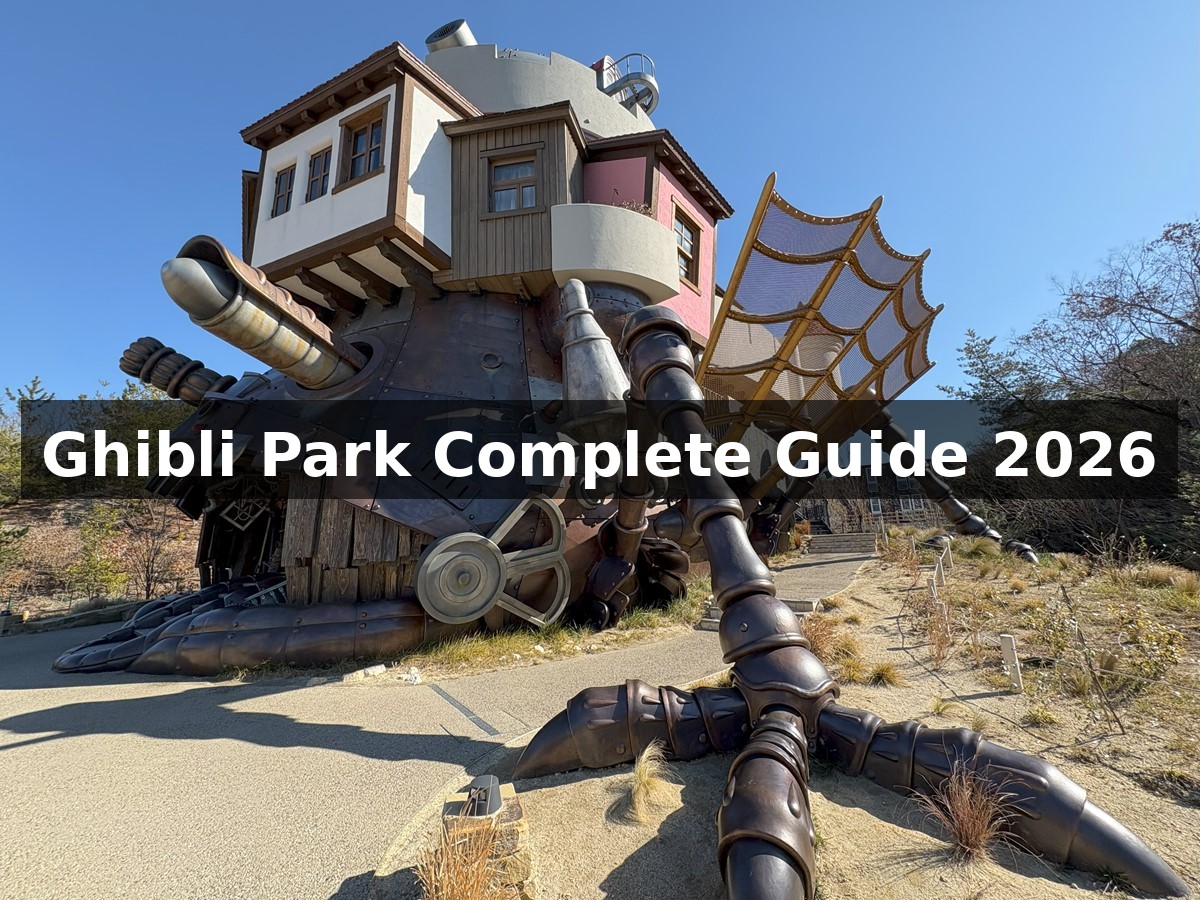
A steampunk-inspired area built around the Elevator Tower (think Castle in the Sky meets Howl’s Moving Castle) and the World Emporium from Whisper of the Heart. The antique shop recreation is extraordinarily detailed — the violin-making workshop, the grandfather clock collection, and the ceramic cat figurines are all there. This area is smaller but worth the time if you care about Whisper of the Heart or Ghibli’s European-flavored films.
3. Dondoko Forest (どんどこ森) — Plan 1-2 hours
The My Neighbor Totoro area, centered on a full-scale recreation of Mei and Satsuki’s house. You can walk through every room — the kitchen, the bath, the upstairs bedroom. The attention to period-accurate 1950s Japanese domestic details is remarkable. Surrounding the house is a forested walking trail that captures the feel of the film’s countryside setting. Young children tend to love this area; it’s calmer and more nature-focused than the Grand Warehouse.
4. Mononoke Village (もののけの里) — Plan 1-1.5 hours
Opened November 2023, this area recreates the Tatara-ba ironworks settlement from Princess Mononoke. The landscape blends traditional Japanese rural aesthetics with the film’s mystical forest atmosphere. It’s more of an outdoor walking experience than an exhibition — the charm is in how the natural terrain has been shaped to evoke the film’s world.
5. Valley of Witches (魔女の谷) — Plan 2-3 hours
The newest and second-largest area, opened March 2024. This one celebrates the witches of Ghibli — Kiki’s Delivery Service, Howl’s Moving Castle, and Earwig and the Witch. There’s a life-size recreation of the Okino residence from Kiki, Howl’s castle exterior, and an Earwig-themed playground area. Because it’s the newest, it tends to be slightly less crowded than the Grand Warehouse, and the buildings are spectacular.
| Area | Time Needed | Opened | Best For |
|---|---|---|---|
| Grand Warehouse | 3-4 hours | Nov 2022 | Everyone — exhibitions, shops, cinema |
| Hill of Youth | 1.5-2 hours | Nov 2022 | Whisper of the Heart, Castle in the Sky fans |
| Dondoko Forest | 1-2 hours | Nov 2022 | Totoro fans, families with young children |
| Mononoke Village | 1-1.5 hours | Nov 2023 | Princess Mononoke fans, outdoor walks |
| Valley of Witches | 2-3 hours | Mar 2024 | Kiki, Howl’s fans — newest area |
If you only have one day: prioritize Grand Warehouse and Valley of Witches, then add Hill of Youth if time allows. That combination covers the widest range of Ghibli films and the most impressive recreations.
How Do You Get to Ghibli Park from Tokyo and Nagoya?
From Tokyo: Shinkansen + Subway + Linimo (about 2.5 hours total)
There’s no direct train from Tokyo to Ghibli Park. The fastest route goes through Nagoya:
| Leg | Route | Time | Cost |
|---|---|---|---|
| 1 | Tokyo → Nagoya (Tokaido Shinkansen Nozomi) | ~90 min | ¥11,300 (~$77) reserved seat |
| 2 | Nagoya → Fujigaoka (Higashiyama Subway Line) | ~30 min | ¥290 (~$2) |
| 3 | Fujigaoka → Ai-Chikyuhaku-Kinen-Koen (Linimo) | ~15 min | ¥340 (~$2.30) |
| Total one-way | ~2.5 hours | ¥11,930 (~$81) | |
The JR Pass covers the shinkansen leg (Tokyo to Nagoya), which saves you ¥22,600 on the round trip alone. If you’re visiting Ghibli Park as part of a broader Japan trip, the Japan Rail Pass pays for itself on this route. The subway and Linimo portions aren’t covered by JR Pass — use your IC card for those.
A direct bus also runs from Nagoya Station’s Meitetsu Bus Center (4th floor, Platform 24) to the park, taking about 40 minutes. There are 7-10 departures daily — check schedules at the bus center or Meitetsu’s website.
From Nagoya Station: Subway + Linimo (about 45 minutes)
Take the Higashiyama Line (yellow line) from Nagoya Station toward Fujigaoka. At Fujigaoka, transfer to the Linimo (an elevated maglev train) and ride it to Ai-Chikyuhaku-Kinen-Koen Station (愛・地球博記念公園駅). Total cost: ¥630. Linimo runs every 10-15 minutes during the day. The park entrance is a short walk from the station.
Can You See Everything in One Day?
Short answer: not comfortably. The five areas together need 9-12 hours of walking time, and the park closes at 5 p.m. (weekdays open at 10 a.m., weekends at 9 a.m.). That gives you 7-8 hours, minus lunch, bathroom breaks, and gift shop time.
Here’s what’s realistic:
One full day (Premium Pass): You can physically visit all five areas if you move efficiently, but you’ll be rushing through at least two of them. Grand Warehouse alone can eat 3-4 hours if you engage with every exhibit. I’d call this “checked the boxes but didn’t fully experience it.”
One full day (Standard Pass): Three areas — Grand Warehouse, Mononoke Village, Valley of Witches — is a comfortable full-day pace. You’ll have time to linger in the Grand Warehouse, eat lunch without rushing, and explore Valley of Witches properly.
Two days (recommended): Day 1: Grand Warehouse + Hill of Youth + Dondoko Forest. Day 2: Valley of Witches + Mononoke Village + revisit your favorite spots. This is how the park was designed to be experienced.
If you’re only visiting once and you chose the Premium Pass, my suggestion: start with Grand Warehouse at opening (it has the most to see), do Hill of Youth and Dondoko Forest before lunch, eat at one of the park cafes, then spend your afternoon in Valley of Witches and Mononoke Village. Skip the gift shops until the end — they’re open until closing time.
Where Should You Stay? Hotels Near Ghibli Park
Ghibli Park is in Nagakute, a suburban area east of Nagoya. There aren’t luxury resorts next door — your options are practical business hotels near transit stations, or staying in central Nagoya with more dining and nightlife options.
| Hotel | Location | Price/Night | Travel to Park | Best For |
|---|---|---|---|---|
| Hotel Route Inn Grand Fujigaoka | 4 min walk from Fujigaoka Station | ~¥9,500 (~$65) | 15 min (Linimo direct) | Shortest commute, natural hot spring bath |
| Hilton Nagoya | Fushimi Station, central Nagoya | ¥20,800-57,100 (~$142-389) | 45 min (subway + Linimo) | International service, restaurants, central location |
| Vessel Hotel Campana Nagoya | 9 min walk from Nagoya Station | ~¥5,000-10,000 (~$34-68) | 50 min (subway + Linimo) | Budget, children under 18 free with parents |
Best overall: Hotel Route Inn Grand Fujigaoka. It’s on the Linimo line so you’re 15 minutes from the park, the price is reasonable, and the onsen (hot spring bath) is a legitimate perk after a full day of walking. Central Nagoya hotels give you more evening options — restaurants, nightlife, Nagoya Castle — but add 30 minutes to your morning commute.
If you’re visiting for two days, staying near Fujigaoka makes the logistics significantly easier. For a single day visit as part of a broader trip, staying at Nagoya Station gives you better shinkansen access for your next destination.
Frequently Asked Questions
When are Ghibli Park tickets released?
On the 10th of each month at 14:00 JST, for dates two months ahead. April 10 opens June dates. Mark your calendar and be online exactly at 14:00 — weekend dates sell out within hours.
Can I buy tickets at the gate?
No. Ghibli Park is reservation-only with no day-of-visit sales. If you arrive without a ticket, you cannot enter any of the five areas.
Is Ghibli Park the same as the Ghibli Museum in Mitaka (Tokyo)?
No. The Ghibli Museum is a smaller, separate facility in western Tokyo. Ghibli Park is in Aichi Prefecture, about 2.5 hours from Tokyo by shinkansen. They are run by different organizations and require separate tickets. You cannot use a Ghibli Museum ticket at Ghibli Park or vice versa.
What days is Ghibli Park closed?
Every Tuesday, except during school holidays (Golden Week, summer break, winter break). Weekday hours are 10:00-17:00; weekends and holidays open at 9:00. Check the official calendar before booking — there are occasional maintenance closures.
Do I need to speak Japanese to visit?
No. Signage inside the park is minimal by design (Miyazaki’s preference), but the experience is visual rather than text-based. Staff at the entrance and ticket gates handle international visitors routinely. The Grand Warehouse gift shop accepts international credit cards.
Is Ghibli Park good for young children?
Yes, particularly Dondoko Forest (Totoro area) and the children’s play space inside the Grand Warehouse. Strollers are allowed on park pathways but not inside buildings — free stroller parking is available at each area entrance. Children 3 and under enter free.
How crowded is Ghibli Park?
Weekends and holidays are consistently busy. Late January through mid-February and mid-November through early December are the least crowded periods. Weekdays generally see 50% fewer visitors than weekends. Arriving at opening time gives you the best experience in the Grand Warehouse before the midday crowds.
Can I bring food into the park?
Yes. The surrounding Expo 2005 park has open lawn areas where you can eat packed lunches. Inside Ghibli Park, there’s a cafe in the Grand Warehouse area, but it gets crowded between 11:30 and 13:00. Bringing onigiri or sandwiches from a Nagoya convenience store is a practical move if you want to maximize your time in the exhibits.
More Area Guides
- PokePark Kanto Tokyo 2026: Tickets, Areas & Tips
- Tokyo Anime District Guide: 5 Areas Every Fan Should Visit
- Akihabara Complete Guide 2026: Anime, Games & Beyond
- Ikebukuro Anime Guide 2026: Otome Road & Beyond
- Japan Rail Pass 2026: Is It Worth It?
- Japan eSIM vs Pocket WiFi: Best Pick for 2026
Follow @japan_pop_now on Instagram for daily Tokyo pop culture updates.

Written by Takapon
Born and raised in Kyoto, currently in Tokyo. Former management consultant turned anime culture writer. Has visited countless collaboration cafes and pilgrimage spots across Japan. Also sharing tips on Instagram @pop_now_jp.
Follow @pop_now_jp on Instagram

Comments